
Implementation
Embedded Telemetry Platform
A modular local telemetry system connecting sensors, ESP32-S3 and ESP8266 nodes, Raspberry Pi services, databases, dashboards, and control interfaces.
Why I am building it
I learn best by implementing systems that interact with the real world. This platform gives me a practical way to work with sensors, actuators, networking, signal quality, physical installation, and interfaces while also making useful systems for daily life.
That experience carries directly into computer vision, AI, and robotics. In all of them, real-world events must be measured, interpreted, and turned into reliable actions despite imperfect data.
Current system
The platform combines distributed ESP32-S3 and ESP8266 nodes with a Raspberry Pi backend. MQTT carries measurements over the local network, while Flask, Socket.IO, and SQLite support live views, history, control surfaces, and stored measurement data.
Implemented parts include:
- Smart bathroom scale: I replaced the scale’s original PCB with an HX711 load-cell ADC and an ESP32-S3. Measurements are logged automatically to my database.
- Apartment monitoring: Humidity, temperature, and illuminance (lux) sensors measure conditions around my apartment.
- Tram departure display: A small display connected to an ESP32-S3 shows the next tram departures from the stops closest to my apartment.
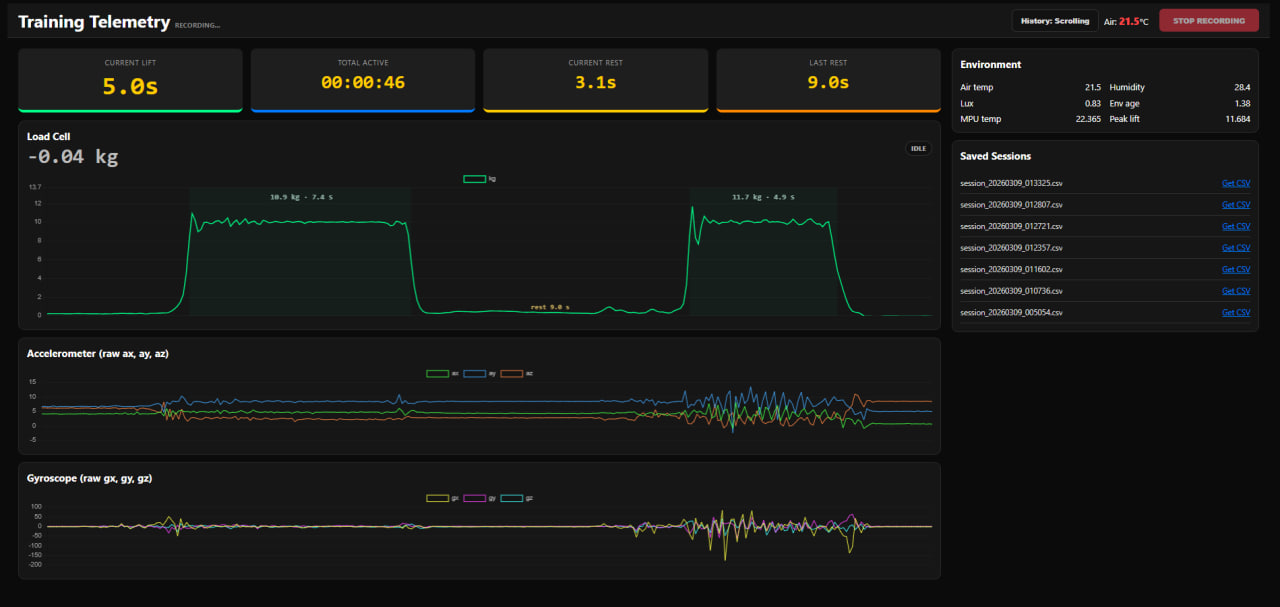
- Finger-strength measurement: Force and motion measurements for training, using an HX711 and a 100 kg S-type load cell. The setup is operated primarily with an ESP32-S3, with Raspberry Pi and ESP8266 support.
Other nodes handle light control and experimental audio capture.
The system has also been tested as a finger-strength testing station at TREY’s Harraste- ja liikuntamessut (hobby and sports fair).
The linked technical notes contain the fuller sensor list, communication details, and planned vehicle integration.